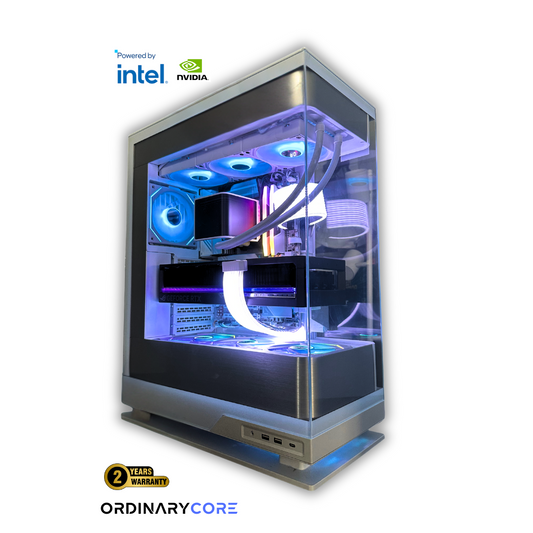

Best Gaming PCs for Football Fans in Canada: 2026 FIFA World Cup Ready
Sadip RahmanShare
World Cup 2026 PC Build Guide: What Canadian Gamers Actually Need
With Canada co-hosting the FIFA World Cup 2026 from June 11 to July 19, we've already had a handful of Toronto clients ask whether they need to upgrade their PCs to handle tournament streaming alongside their usual gaming load. The short answer: streaming a TSN+ broadcast at 1080p is one of the lightest tasks a modern PC will do all year. Your gaming resolution is what should drive the build, not the football.
TSN holds Canadian rights to all 104 matches, with TSN+ priced at CA$8/month or CA$80/year, and 45 games also airing on CTV. None of that requires anything beyond mainstream desktop hardware. The real question is whether your system can game smoothly at the resolution you actually play at while a match runs on a second monitor or a browser tab. For high-performance gaming builds, explore our website.
Streaming Load Is Not the Bottleneck
A 1080p stream from TSN+ or CTV pulls roughly 5-8 Mbps of bandwidth and uses hardware decoding that's been standard on Intel and AMD CPUs for years. Even a 5-year-old Ryzen 5 or i5 will handle it without breaking 5% CPU utilization. If your build can run Cyberpunk at 1440p, it can run a football broadcast in a Chrome tab.
What actually causes performance issues during simultaneous streaming and gaming is RAM headroom and GPU memory pressure, not decoding capability. A 16GB system running a competitive title at high settings, OBS in the background, Discord, and a browser with a live stream will start paging to storage. The 1% lows tank. The stream stutters. People blame the network. It's almost always memory.
The Real Spec Question: What Resolution Do You Play At?
This is where the build decisions actually live. The published baseline for smooth competitive play in 2026 is still a modern 6-core CPU, 16GB of dual-channel RAM, and a midrange GPU paired with a 144Hz display. That's the floor, not the target.
If you're playing EA Sports FC, Rocket League, or other esports-leaning titles at 1080p, that baseline holds up fine. The frame consistency matters more than peak framerate, and a 144Hz panel does more for your experience than any CPU upgrade past a Ryzen 5 7600 or Core i5-14600K.
The picture changes at 1440p Ultra and above. A reasonable tier for that resolution pairs a Ryzen 7 9800X3D with an RTX 5070 Ti-class GPU, 32GB of DDR5-6400, and a 2TB NVMe drive. Push into 4K Ultra or high-refresh OLED territory and you're looking at Ryzen 9 9950X3D, RTX 5080 or 5090, 64GB of DDR5, and storage that can handle modern game install sizes without constant juggling.
One opinion worth stating plainly: if you're playing competitive football titles at 1080p and buying a 64GB DDR5 kit because someone told you it was future-proofing, you're spending $400 on a problem you don't have. Put that money into the monitor.
Where Your Money Actually Matters
The Canadian gaming PC sweet spot still sits between $1,500 and $2,500 for the system itself. That range gets you into proper 1440p territory with components that won't bottleneck each other within 18 months. Below $1,500, you're making tradeoffs that show up under load. Above $2,500, you're paying for headroom most buyers won't touch unless they're also doing content creation or streaming professionally.
A few practical priorities for World Cup season specifically:
- Display refresh rate. 144Hz is the minimum for any competitive title. The jump from 60Hz to 144Hz is more visible than any GPU upgrade you'll make this year.
- RAM capacity over speed. 32GB at DDR5-6000 will serve you better than 16GB at DDR5-7200 if you multitask at all.
- Storage capacity. Modern football and sports titles hit 80-120GB per install. A single 1TB drive fills up faster than people expect.
- Cooling headroom. Toronto summers and a closed office during a 4-hour streaming session add up. Tower air coolers or a 240mm AIO handle this without thermal throttling.
Pro Tip: If you're watching matches on the same machine you're gaming on, run the stream on a second monitor at 60Hz rather than your main 144Hz panel. It cuts GPU encoding overhead and frees up frame budget on the primary display.
Build Tiers at a Glance
| Target Resolution | CPU | GPU Class | RAM | Display |
|---|---|---|---|---|
| 1080p Competitive | Modern 6-core (Ryzen 5 / Core i5) | Midrange | 16GB DDR5 | 144Hz minimum |
| 1440p Ultra | Ryzen 7 9800X3D | RTX 5070 Ti class | 32GB DDR5-6400 | 144-240Hz |
| 4K Ultra / OLED | Ryzen 9 9950X3D | RTX 5080 / 5090 | 64GB DDR5-6400+ | 4K 144Hz+ |
These are configuration guidelines from current published build tiers, not benchmarked outcomes. Real-world performance varies by title, driver version, and how aggressively a given game pushes ray tracing or upscaling. For sports and football-focused titles specifically, the CPU matters more than the GPU at 1080p, and that flips hard once you cross into 4K.
What Gets Overlooked
Two things consistently come up in our build consultations that buyers underestimate. The first is power supply quality. People will spend $1,400 on a GPU and pair it with a $90 PSU. When transient spikes from an RTX 5080 hit a marginal unit, you get random shutdowns mid-match. Spend the extra $50 on a quality 80+ Gold or Platinum unit with proper rail headroom.
The second is case airflow. A glass-front case looks great in photos and traps heat under sustained load. If you're running long matches plus gaming sessions on summer days in Ontario, mesh-front cases handle the thermal load substantially better. We see GPU temps drop 6-9°C just from swapping the chassis.
Frequently Asked Questions
Do I need a special PC to stream the FIFA 2026 World Cup in Canada?
No. Any PC built in the last five years handles a 1080p TSN+ or CTV stream without effort. The question is whether you're also gaming on the same machine at the same time, which is where RAM and GPU headroom matter.
Is 16GB of RAM enough for gaming and streaming matches at the same time?
For 1080p gaming with a stream on a second monitor, usually yes. The issue shows up if you also have Discord, a browser with 20 tabs, and OBS running. 32GB removes the guesswork and is the safer baseline for anyone doing serious multitasking.
Should I wait until after the tournament to upgrade?
If you're upgrading specifically for the World Cup, no - the tournament doesn't demand it. If you're upgrading because your current system struggles at the resolution you actually game at, the timing doesn't matter. Buy when your use case justifies it.
Building for Your Setup
The hard part of any PC decision is matching the components to how you actually use the machine, not how you imagine using it. A buyer who plays football titles at 1080p with a stream on the side has very different needs from someone running 4K simulation games with a broadcast in picture-in-picture. If you're trying to figure out which tier makes sense for your specific room, monitor, and gaming habits, a conversation with our team usually saves people from either overspending or undershooting.
We build every system in Toronto and test under sustained load before it ships, which is the part that catches the issues spec sheets don't predict.
Explore More at OrdinaryTech
- Browse our ready-to-ship gaming PCs if you need something configured and tested before kickoff.
- See our custom gaming build options for fully spec'd configurations across all three resolution tiers.
- Read client success stories from gamers and creators across Canada.
Written by Sadip Rahman, Founder & Chief Architect at OrdinaryTech - a Toronto-based custom PC company that has built over 5,000 systems for gamers, creators, and businesses across Canada.